Sad

It feels like there are no words. When we found out I was pregnant, we told our families and our closest friends. Today I had to tell them that I am miscarrying. They all console me and ask if I want to talk, but what is there to say? There is so much to feel, and nothing to say.

Last night I started bleeding while watching a video on how babies develop in the womb. My wife was assigned to watch the film for her Human Growth and Development class, a prerequisite to the nursing program she is trying to get into. I was excited to watch along, and to imagine the new life growing in me.

When I saw the blood, my heart sank. Maybe it’s okay, I told myself. Many women bleed a little in early pregnancy. But it didn’t feel okay.

I dreamt about miscarriage. I dreamt about death and tears and sitting alone on dark bathroom floors.

I woke up to more blood. As I went to the bathroom, more blood. Clots. So much blood. I cried as my body brutally expelled my hopes and dreams. Over the next day or so, I will watch as my body eliminates life.

I walked out to the sun room and sat on the rocking chair. My toddler climbed up into my lap and immediately began kissing my face. “Mom sad? No sad. No Mom sad.” Her little lips pressed together then pressed to my cheek. She cradled my head in her hands and kissed me over and over again.

At least it happened early, I tell myself. I can always try again. But there is little solace there. I know that things will be okay in the long run, but today is not the long run.

I am so thankful for this precious little girl, covering my tear-streaked face with her kisses. I am also overwhelmed with grief for the kisses I had anticipated giving my newborn in February—kisses that will never come to be.

I know I will kiss another. I know my body will heal and I have heard that there is an increased chance of conceiving shortly after miscarriage. I know these things, but right now I don’t feel them.

Yesterday I was pregnant. Today I am not. And right now I just feel sad.

Happy

If it’s positive, I told myself, I will keep it a secret and then surprise my wife on June 6, our anniversary.

I placed the cap over the tip of the pregnancy test, setting it down on the counter face-up as the directions on the insert instructed. In the movies they always put it face-down, I thought. I understood why. It seemed safer, less anxiety-producing. Not wanting to compromise accuracy, I placed it face-up. Not wanting the stress, I tucked it behind a picture frame.

I walked out into the kitchen. I picked up Pidge and gave her a little nuzzle. My wife poured us some coffee – mostly decaf, of course. We talked about something, I don’t know what. My mind kept thinking about the test and my eyes kept wandering over to the clock. Three minutes has never felt so long.

My close childhood friend has been trying to get pregnant, too. We both started trying around the same time. Five days ago, I learned that this try worked. She was pregnant. I was ecstatic, but also a little jealous. It happened so quickly for her! Of course, she had a husband and what seemed like infinite opportunities for insemination whereas we only had two tries each month. I worried about how long it would take me. Would our donor get tired of helping us out? My mind was awhirl. The two-week wait between ovulation and when you can learn whether you are pregnant is just awful.

Shortly after I got off the phone with my friend, hopeful and experiencing what seemed like pregnancy signs, I took a test and it was negative. I knew it was an early test, and that sometimes early tests will come back negative even if you are pregnant. I took it after I had been getting mastitis-like symptoms. Given that Pidge has been gradually decreasing the amount she is nursing, this seemed odd. Maybe it means I’m pregnant. . . But no matter how hard I squinted, the test displayed only one pink line, dark and stark in contrast to the white space where the other line could have appeared. I hadn’t told my wife.

I set down my coffee – three minutes were up. I walked back into the bathroom. I was hopeful, but doubtful. The other test was probably right, I thought to myself. I reached back behind the frame.

TWO LINES.

IMG_6614-1

It was faint, but it was unmistakably there. I could hardly believe my eyes. My hand started to tremble.

Suddenly, all my planning about waiting to tell my wife went out the window. I sprinted into the kitchen, shaking. My wife knew before I could say anything. I beamed, she shrieked. We hugged and held each other. We were overcome with joy.

I took another test, a digital one this time. Pregnant. We could barely contain ourselves.

IMG_6615-2

My cycle-tracking application gave me the option to switch into pregnancy mode. “You are 4 weeks and 6 days along. Your embryo is currently the size of a red lentil.” The app gave me the option to choose a nickname for my growing baby. While Pidge was developing inside my wife, we called her Sprout. What should we call this one?

I picked up Pidge. “You’re going to be a big sister!” I told her. She smiled. I asked, “What should we call your baby sibling?” She paused and said “hmm,” putting her pointer finger up against her chin like she does when she’s being extra thoughtful. A few moments later she held her little finger up in the air, indicating she had an idea.

“Happy.”

Pidge grinned at me and I grinned back. Happy. It was perfect.

Cycle Day: March

“This is the time of year that makes Vermonters strong.”

It was one of the first things said to me when my wife and I moved to Vermont in 2012. At the time, we didn’t understand. How could we? At the time, we were still star struck by our new state, in awe of the bare trees, the shadows they cast, the rock formations proudly jutting out of the landscape, and the snow. The pretty white snow blanketing any misgivings we may have had about moving 3,000 miles away from our families.

Today, we know. Even as people who love winter, the snow and the skiing, the coziness of inside, we understand the meaning of that statement uttered to us seven years ago. March is hard. Winter, despite its beauty, is long. It is dark and cold and icy. Our days are predominantly spent inside and our skin longs for the warmth of the summer sun. Unlike many places in March, Vermont is not abloom. Vermont still vacillates between arctic chill and sloshy mud. The wind howls and everything, including much of the snow, is brown. So much brown. Everything is dirty, everyone is inside.

Our first spring with a toddler, this March has been especially tough. She has no place to run or stretch or dance in our little home. She began experiencing slight delays in her gross motor development.

Adding more mud to March, Pidge is having health issues. She began experiencing a phenomenon where her hands and feet and lips would occasionally turn blue, something called cyanosis. Her pediatrician ordered some tests, and the results were frightening. Hypothyroidism. Possible autoimmune disease. Possible Type I diabetes. Blockage in the heart. We held back our tears but stress and fear welled up.

I was trying to get pregnant and my period was eight days late, but every pregnancy test was negative. What was going on? I felt trapped between waiting and pregnancy. Women who are trying to conceive monitor their cycle days. I felt like I was in cycle day March.

But here’s the thing. March is how you look at it.

IMG_2372

Pidge looking out the window at March

Fifteen years ago, I was living with my brother in Northern California. I remember lounging on my back on the living room sofa reading a book, when I looked up and saw the moon perfectly framed in the highest window. It was full and clear and there was even a redwood tree right next to it, like a postcard picture. I pointed it out to my brother, who was in the kitchen.

Look. The moon.

The only trouble was, from where he was the moon was blocked by a big piece of house. There was no moon, no postcard redwood in his view.

But instead of telling me it wasn’t there, he set down the pan he was washing and walked over to me, leaning and tilting his head until he could see my moon in the window.

And I’m thinking about this because I’m thinking about March, and about what a difference a little perspective can make.

Pidge’s cyanosis led us to have her tested at Dartmouth for a whole host of health issues. We are thankful that we are able to get ahead of these issues, and to treat as necessary. And, according to her pediatric endocrinologist and pediatric cardiologist, her prognosis is actually much better than we thought.

After forty days of waiting, I started my period. I am not pregnant. Not this time. But at least the waiting is finally over. My hope is renewed, and I am excited to try again.

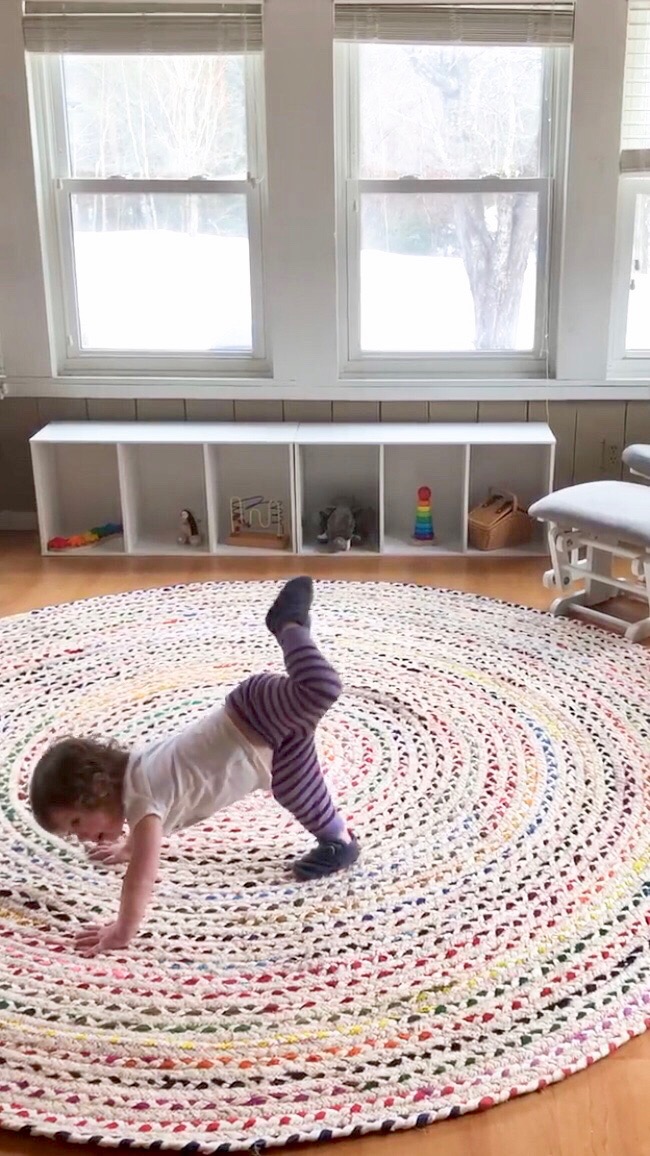
Last Sunday, I redecorated a room in our house. If we are going to be stuck inside, I thought, let’s create some space to move. I got rid of bulky furniture and added a big, bright, colorful rug. When Pidge saw it, her eyes instantly brightened. She ran over to her rug and danced.

Maybe March is tough and beautiful. Maybe the snow is tedious and brilliant. Maybe it is making the most of inside time with a dance on a rainbow rug. Maybe it is just a matter of walking into a new room to come see that there really is a moon in the window.

7A38A4A9-79C4-4E77-B7A2-331379248D88

First Try

Just relax, I told myself. I looked at my phone to pass the time and to occupy my mind. I was in the bedroom alone, preparing myself for my first insemination.

A week earlier, after my first period since our daughter was born had come and gone, I began tracking my ovulation. Tests and mucus and body temperature—before trying to conceive, I had no idea how complicated all of this stuff is. And we’ve got one shot each month, so we have to get it right. No pressure.

Then Thursday morning it happened. The digital indicator on our ovulation predictor kit showed a smiling face. My heart stopped. Oh my gosh, I thought. It’s time.

We called our donor who, several months prior, had signed a contract with us to facilitate the process. He agreed to come over that evening and the next day as well.

I spent the next eight hours desperately trying to focus on work, but my mind was elsewhere. I wish we had tried yesterday, I thought. I knew from my copious amounts of research that it is better to inseminate prior to ovulation. The smiling face indicated that it was likely I would ovulate in the next 6-48 hours, but that’s all. If it was later, we still had time. If it was earlier, we missed the window.

But I had to stay positive and relaxed. Everyone tells you not to stress, because stress inhibits conception. From experience I can say that this is much easier said than done.

I waited in the bedroom. I heard our donor come in, greet my wife and daughter, and then head to the bathroom. A little while later, I heard the sink run. He walked downstairs and said to my wife, “I left it on the counter. Good luck!”

As he drove away, my wife and daughter came into the bedroom. “Mom!” my 18-month-old exclaimed. “Mom, Mom, Mooommmm.” She shimmied onto the bed and climbed on top of me, rubbing her face against mine. My wife got the sterile cup and syringe ready. I laughed. Trying for number 2 is so different than trying for number 1, I thought. My daughter giggled and played with a tube of Pre-seed.

“Okay, Pidge. Let’s go.” My wife scooped up our daughter. “Bye bye!” our daughter waved cheerfully.

I took a deep breath and held my legs up in the air. My wife leaned down and kissed my cheek. She smiled. I smiled back, full of nerves and hope. “As of right now,” she said, “we officially have a chance.”


Birth.

I woke up to the sound of my wife’s voice. Groaning. Moaning. Repeatedly catching her breath.

“You okay?” I asked. “Do you think this is it?”

“I’m not sure,” she replied.

It made sense that it would be labor. My wife was two days past her due date. Still, we were both intensely aware of the fact that most expectant parents with first-time pregnancies think they’re in labor before they actually are. We weren’t going to be those people, we told ourselves.

But the pain continued. My wife described it differently than she did the Braxton Hicks. Lower. More intense; more consistent. I sent my boss an email telling her I would not be working that day. “We think my wife’s in labor. . . .” I sent our midwives a text.
IMG_0404 2

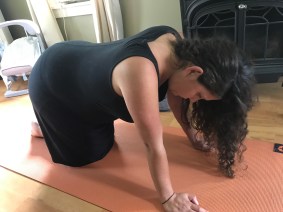
A week prior I had built a birthing tub and set it up in our living room. I hooked up the hose to the sink and began to fill it. I was trying not to get my hopes up, but I was excited. My wife grabbed a yoga mat, spread it on the floor of our living room, and got on her hands and knees. “Ohhh,” she groaned, arching and bowing her back.

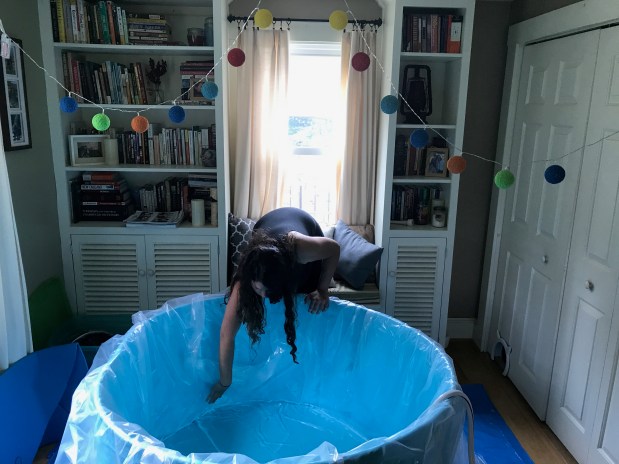
I ran around the house, trying to make everything perfect. I hung the rainbow lights my wife loved above the birthing tub. I fed the dogs. I let out the cats. I brought her breakfast, coffee, water. Lots of water. Tea. I got my Birth Partner book and propped it open to the chapter marked “Labor.” I checked the water temperature.

“Is the tub ready?” my wife asked. I looked at the water. It wasn’t even a third of the way full. I looked back at my wife and shook my head. I felt the hose—cold. Damn our little water heater, I thought. I turned off the water to wait for it to reheat. My wife reached over and ran her fingers across what little water filled the bottom of the tank. She stripped down and got in.
IMG_0397 2

I texted the midwives, who told me that my wife could labor in that state for quite a while. Days, even. Really? I thought. They said she/we should eat. They said that while the tub’s relaxing for her, I really should try to get her on a walk if she wanted to “get things going.” I looked over at my wife, her face scrunched in agony. I wished myself luck as I asked if she wanted to go for a walk. She looked at me like I was nuts and said, “No way.” Eventually we did get her to walk around the yard, but that was about as good as I could get it. I never could get either one of us to eat.

For the next several hours she was in and out of the tub. I was running water over her. Rubbing her shoulders. Rubbing her back. Asking questions and getting snapped at (my fault). Watching helplessly as she suffered. Hearing her desperate cry of “help me” and not knowing what to do.

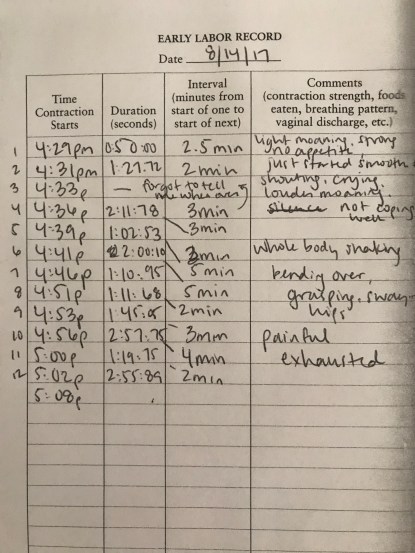
Early afternoon, it sounded like my wife was in pain every second. Maybe I should time the contractions, I thought. I got a chart I had printed and asked my wife to tell me when the contractions were starting and when they were stopping. “They don’t stop,” she said. “They just get slightly less intense.” I opened the stopwatch feature on my phone and recorded the times as best I could. They were really close together.
IMG_0907

I sent the midwives a text with all the information about her contractions: duration, interval, observations, notes. They asked if we wanted them to come over. Just as I was about to respond that we were fine, my wife’s water broke. “We’re coming.”

“Ahhhhhhh!” my wife shouted. The pain was increasing, and my ability to be useful was decreasing. I tried to think of everything I could do to make my wife more comfortable. Music. My wife loves music. She has her phone hooked up to a special Bluetooth speaker and creates all sorts of playlists. However, she’s always the one who puts the music on in our house, and I had no idea how to work her devices. I picked up her phone and tried to figure it out. I pressed a button that looked like a music note and then I pressed play. Mariah Carey blasted through the speaker. I cringed. I looked at the playlist – something about “liked” or popular songs. I had no idea how to change it. Apparently this baby would be born into a 90’s dance party. Oh, well!

My wife was on the floor when Midwife 1 arrived. She took her blood pressure. She took her pulse. She listened to the baby’s heartbeat. Strong. I stroked my wife’s back while the midwife placed various items around our house, pausing every so often to ask me where certain things were. As she distributed her belongings, she swayed to Mazzy Star. She boogied a little to N*Sync. She jammed to Phish. I shook my head at the ridiculous hodgepodge playlist. “Sorry!”

Midwife 2 arrived. Together the three of us helped my wife to the bathroom. She labored backwards on the toilet for what seemed like hours. The midwives stopped her every so often to listen to baby’s heartbeat. You could hear the heartbeat echoing off my wife’s pelvic bones. The baby’s descending.

I walked out to the kitchen to find Midwife 2 knitting. I offered our guest bed if she needed a rest or if this continued on for a while. She looked at me and chuckled. “Your wife is pushing,” she said. “You’re having this baby very soon!”

Throughout the whole evening, my mind and emotions had been vacillating between focus and fog. In one moment, I was sharp. In another, I was lost. But throughout the entire experience there was one emotion that remained constant: excitement. This was really happening. We were having a baby.

My wife continued to labor on the toilet. Eventually, Midwife 1 looked at me with urgency in her eyes. She whispered, “This baby is coming now. We need to move your wife.” We coaxed and prompted, but were met with resistance. Finally, we got my wife off of the toilet and onto a low to the ground, crescent-shaped birthing stool.

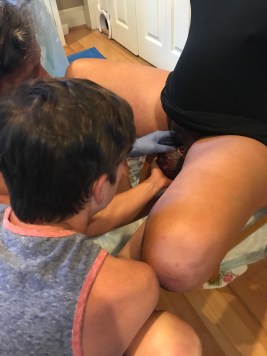
“You can see the head,” Midwife 1 said. She held the flashlight as I looked in. There it was! A little brown swirl of hair. My heart skipped a beat and a huge smile spread across my face.

“Do you want to see it? Do you want to feel?” I asked my wife, but she was so lost in her pain that she couldn’t do it. All she could do was push. I positioned myself between my wife’s legs as INOJ’s Let Me Love You Down pulsed through the speakers in all its teenage glory.
IMG_0427

She pushed once, and a head began to emerge. “This hurts like hell!” she screamed.

Second push, and the head was out. There was a pause between the contractions. I cradled the head in my hands, the first person to ever touch this little being outside of my wife. My daughter. This is my daughter.

Third push, and a little body slithered out of my wife and into my arms. The umbilical cord was wrapped around her neck and body, and the midwives and I twisted and turned her around until she was untangled. We heard her sputter and then we heard her cry. It was the most beautiful sound I had ever heard. I lifted her tiny body up to my wife’s chest as she cried, “My baby, my baby, my baby. Oh, sweetheart.” I wrapped my arms around my wife and began to sob. I was overwhelmed with love and admiration.

Blood poured down between my wife’s legs. The baby had pulled part of the placenta off the uterine wall when she came out. The midwives ran about, attending to all my wife’s needs. They gave her a shot of Pitocin to contract the uterus, the first drug my wife received throughout this whole process. They gave her herbs. It felt like a movie where my wife, my baby and I were in focus as the rest of the world moved around us in a hurried blur.

We moved over to the couch where my wife continued to cradle our child. We stared into our daughter’s little face as my wife birthed the placenta. “Oh, you’re perfect,” I repeated. My eloquence long lost to overwhelming emotion, I showered my daughter and my wife in short statements of adoration. I reached out my finger, which was quickly grasped by the tiniest hand I had ever seen. I thought my heart would burst out of my chest right then and there.

IMG_0496

The midwives took care of everything as my wife and I held each other and snuggled our baby. We could not stop staring at her, touching her, kissing her wet new skin, telling her how loved she was. I pulled myself away long enough to cut the umbilical cord. The midwives stepped away to cook us food, clean our house, and eventually help us up to bed. After several hours of snuggling in our bed-nest, Midwife 1 performed the new baby exam. 8 pounds, 6 ounces. 22 inches long. Born at home at 7:38 PM.

Perfect.


Paralyzed

52311054767__8C9EBC3F-2533-4B0C-9184-CDA4B5E55399“I can’t close my eye.”

I lift from my pillow and look over at her. Her eye is puffy and red. Her face is awash with fear.

“What’s happening to me?” she asks.

I don’t know. I don’t know what’s happening to her.

What I do know is that her mouth barely moved when she spoke. What I do know is that I am worried.

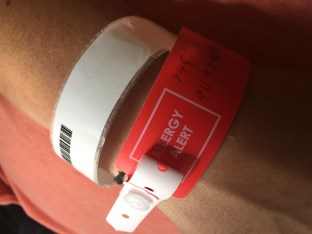
We call the midwives, who urge us to go to the hospital. We go.

Hospitals are so strange. Simultaneously sterile and sickly, I find myself using sanitizer every two minutes. I don’t like that my wife is here. I don’t like the idea of her getting sick or the baby getting sick. I also don’t like what is happening. I don’t understand what is happening, but I know that I don’t like it.

One half of my wife’s face is completely paralyzed. She can’t blink and she can’t move her mouth. One eyebrow lifts slightly higher than the other—the left side of her face alert, the right, drooping.

We are called into triage where a friendly man asks my wife what is happening. She can’t talk. I explain how yesterday her ear hurt. Her ear still feels clogged. Her head hurts and last night her mouth started to tingle. Today, terror.

He asks her to squeeze his fingers, to press her knees up against his resistance, to kick her feet. Good, good, good. Most likely not a stroke. We breathe a collective sigh of relief. So what is going on?

We are escorted to a room. We wait. The waiting is both frustrating and a relief. If they aren’t treating this as urgent, maybe it isn’t so serious. I send a quick text to update friends and family. My wife reclines on the bed, sits up, stretches, paces. She’s anxious, and this clinical setting is doing nothing to allay her fears. “I’m so glad we’re not planning to birth in a hospital,” she says.

Eventually a doctor comes in. Thank goodness.

“Bell’s Palsy,” he finally proclaims after examining her. “We have no idea what causes it. It usually goes away on its own, but we have some meds that might help. I have to check and see if they’re safe for pregnancy, though.” He leaves the room.

Our heads are spinning. Bell’s Palsy? Out of all the complications we feared, this was not one of them. Neither of us know very much about it. At least it isn’t a stroke, we tell ourselves. At least it’s not Lyme. At least they’re not forcing us into an emergency C-section. At least.

The doctor comes back in the room with a clipboard. He tells us about the medication he’s prescribing. He tells us that facial function may return in six months to two years. Two years. The words hang in the air like smoke.

We leave the hospital and head to the pharmacy. We drop of my wife’s prescription. We pick up an eye patch. We start driving out to pick up our farm share. My wife cries silently beside me. I know this is not what she had hoped, not what she imagined. She’s in pain, she’s in disbelief. She’s unable to use half of her face.

Next day, we head to Northampton, Massachusetts to get my wife a prenatal massage. We tell the massage therapist about the Bell’s Palsy. We tell her we hear it’s more common in pregnancy. She tells us that in the twenty years she’s been offering prenatal massage, this was the first she’d heard of it. She tells my wife she’s afraid she’ll fall off the table due to lack of depth perception. Then she tells my wife to relax. Right, I think. Because this conversation has been really relaxing.

I walk around town while my wife gets massaged. Northampton is known as a lesbian haven, and I pick up a cute onesie that reads: Proud of my moms. I browse a few more shops then head back to pick her up from her massage so we can browse together. The difference between walking the streets alone and walking with her is striking. I can feel her distress and embarrassment. She struggles with whether to wear the eyepatch as her increase in physical comfort directly corresponds with her increase in emotional discomfort. I sense her anxiety as we walk. I sense the eyes of others, darting toward her then darting away. Mind your own business, I think. I hold her hand tighter.

We head home and decide to beat the heat with a dip in our local river at the dam where the water pools. When we arrive, my wife panics. The shore was teeming with children. “They won’t bother us,” I assure her. She apprehensively follows me to the water. She dips in.

For a moment, I can see her relief. For a moment, I watch as the cool water washes away her stress. I smile. She looks back at me through her non-eyepatch eye. It’s impossible to hear over the roar of the rushing water spilling over the dam, so she signs “sorry” and “I love you.” I sign back, “I love you, too. You’re beautiful.”

Just then, a pre-teen boy runs over. “I like your eye patch, pirate lady!” he shouts. Embarrassment floods over me. I’m appalled. “You need a sword!” Before I can do anything, the boy chucks a stick at my wife, runs to a nearby rock, and crows like Peter Pan.

I look over at my wife, thinking she will break down, worried she will start sobbing and that I will be unable to help her in any meaningful way. But she doesn’t cry. She just stares.