Every time he walks onto the playground, I find myself flashing a quick glance at Pidge, looking for signs of recognition. Sometimes she acknowledges him, mentioning him by name later in the evening just as she would for any one of her friends’ parents. Sometimes when he says hi to her she just stares.
We live in a small, rural community, which means lives overlap. A lot. Everyone crosses paths with everyone all the time. The idea of if-you-dress-a-mess-you’ll-run-into-someone-you-know is not a thing here because you are always running into someone you know. It’s the nature of living small.
Using a known donor to conceive Pidge has been an interesting experience. When we were looking to conceive several years ago, we weighed the ideas of using a sperm bank versus a known donor. As an attorney I knew that using a sperm bank was the safer route. Parentage is more easily established that way, and it doesn’t create the possibility where the donor could try to claim legal rights to your child. However, there were also aspects of using a sperm bank that concerned me. In this digital age, I am watching concepts of privacy and anonymity lose their meanings. I feared that even if we chose an anonymous sperm donor, our daughter might one day be able to find out his identity. What if we didn’t like him? Would she suddenly be wanting to spend time or holidays with a man we didn’t know and didn’t like? Would she end up with something like 32 siblings, as I had read about in the news?
We decided to ask a friend of ours who lived across the country to donate sperm. We were nervous to ask, worried it would be weird or jeopardize our friendship. Instead, he eagerly said yes, adding, “Y’all will be great parents.” We were overjoyed. As he is an attorney too, he and I worked hard to ensure that both of our legal rights would be protected. He wanted to help us, but he didn’t want to end up stuck with parental obligations; we wanted his help, but we didn’t want him to be able to claim legal rights to our child. Being across the country from one another, we felt as though we had an added layer of protection—it was unlikely that our paths would cross without concerted effort. After many months of contracts and research and reaching out to other attorneys, we started trying. Each time, the attempt to conceive was unsuccessful. We grew discouraged.
One evening, as I was working late, my wife went out for drinks with a colleague of hers. He was more of an acquaintance than a true friend, but they were friendly with each other and enjoyed each other’s company. He told her about how he and his wife were working on buying their first home together, and she told him about our failed attempts at trying to make a baby. Then he commented, “You know, if you ever need help with that, I would be happy to help.” My wife smiled and said thanks, but didn’t think much of it. When she told me about her conversation, I couldn’t believe what I was hearing.
“Do you think he’s serious?” My wife said she thought he was.
“Maybe we should do it,” I said to her. “I mean, what we have been trying has not been working. Maybe it’s because our donor is far away, or maybe there is something with his sperm. Whatever it is, maybe it wouldn’t hurt to try someone different.”
My wife thought about it. She thought about her colleague, and his generous offer. “He does look a lot like you,” she remarked.
She was right. He is taller than I am, but has the same color hair, the same texture hair, and the same color eyes. While I didn’t know much about him at the time, I knew he was smart, funny, and kind. Still, I was concerned about the fact that he lived in town, and that it would be possible that our children would be around the same age.
After several follow-up conversations with him, and after he discussed it with his wife, we decided to move forward using him as a donor. Three cycles later, my wife was pregnant.
My wife’s pregnancy was filled with emotion. We were so excited to become parents, but I was worried. What if I wouldn’t feel connected to this child? What if our donor decided to try to assert legal rights at the last minute? What if he changed his mind once our child was born? What if he started seeing the child as his? What if we see each other constantly and it is weird? What if our kids become friends? There were so many unknowns and, even with legal contracts, there was so much trust I had to place in a man I barely knew.
Fast forward two years and I am watching him play with his child on the playground. His child squeals with delight—“Daddy!”—giggling as his father pushes him on the swing. My daughter is playing with another child on the slide. I look over at the swings and I look back at my child. I study her face, looking for his face. I look for similarities between his child and mine. But I don’t see them. At least, not really. Sure, they are both adorable. Some of their features share certain aspects, but you would never pick them out as siblings in a crowd. Her face is not his—her face is simply my daughter’s face, perfect in every way.
Our relationship with our donor has been beautiful. His child and our child are friends, and our daughter knows him as her friend’s dad. Our donor has never once crossed any boundaries or even attempted to cross boundaries, which has been wonderful. His wife is supportive and similarly hands-off. When I see their child, I have a brief moment where I recognize that their child and our daughter are related. I mention that to my wife. She casually says, “Oh, I guess you’re right. That doesn’t really occur to me much.”
Of course, some day we may have to cross that bridge. Our contract allows us to reveal our donor to our child when she turns 18, or earlier with written consent of all three of us: my wife, the donor, and myself. But that is an issue for a later date.
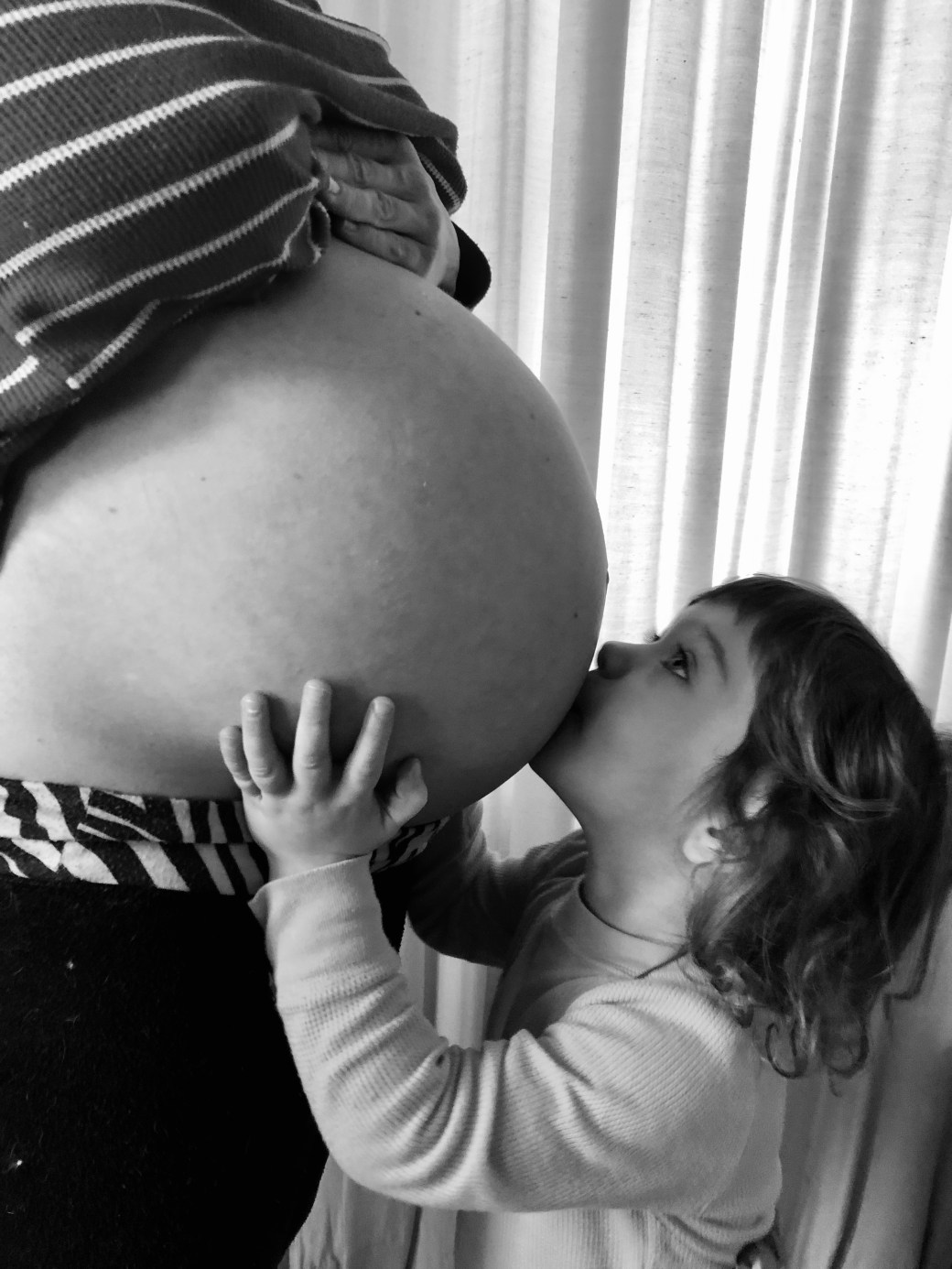
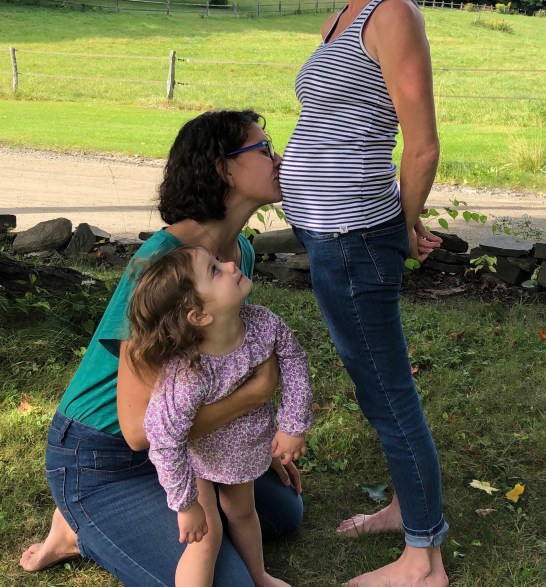
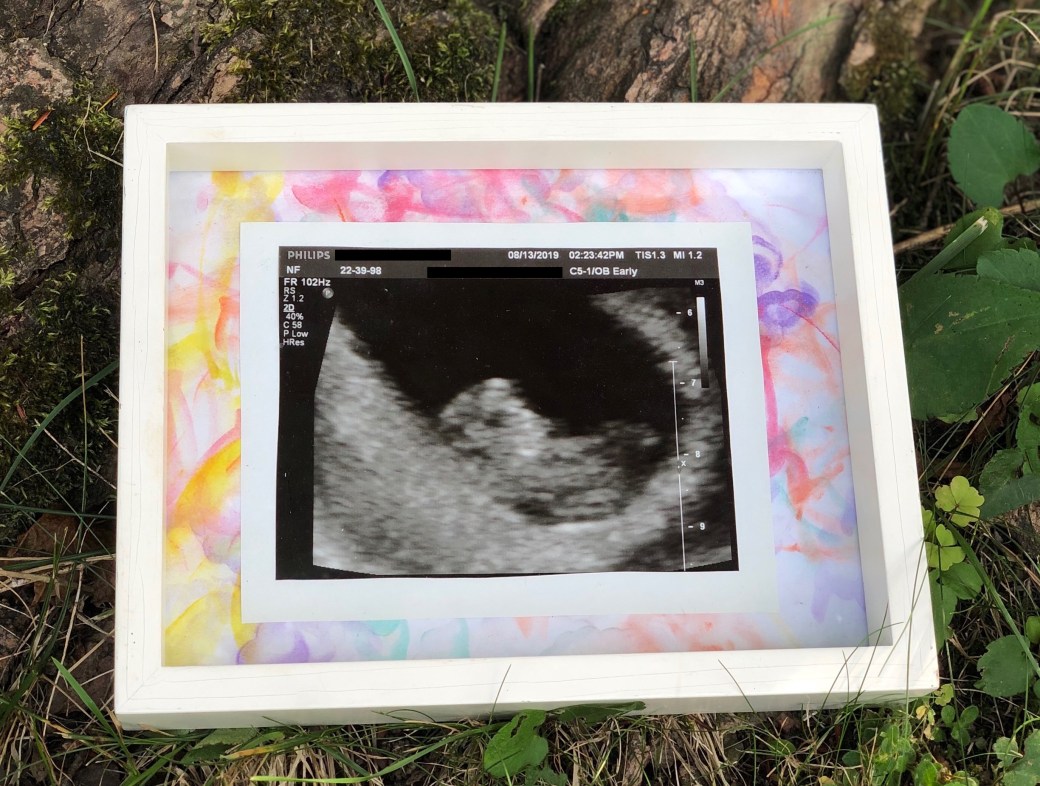
Today, things are more simple and more beautiful than I could have ever imagined. I am pregnant with our daughter’s sibling, conceived with the help of the same donor. Over the course of being Pidge’s mom, I’ve come to realize that genetics mean far less to me than I thought. Still, I am excited about the fact that Pidge and her sibling will be genetically connected—not through their moms, but through the selfless giving of their donor. Their known donor, who we will always be thankful for and love.

Pidge, after a successful day of painting at preschool



 sugar on snow