Known Donor

Every time he walks onto the playground, I find myself flashing a quick glance at Pidge, looking for signs of recognition. Sometimes she acknowledges him, mentioning him by name later in the evening just as she would for any one of her friends’ parents. Sometimes when he says hi to her she just stares.

We live in a small, rural community, which means lives overlap. A lot. Everyone crosses paths with everyone all the time. The idea of if-you-dress-a-mess-you’ll-run-into-someone-you-know is not a thing here because you are always running into someone you know. It’s the nature of living small.

Using a known donor to conceive Pidge has been an interesting experience. When we were looking to conceive several years ago, we weighed the ideas of using a sperm bank versus a known donor. As an attorney I knew that using a sperm bank was the safer route. Parentage is more easily established that way, and it doesn’t create the possibility where the donor could try to claim legal rights to your child. However, there were also aspects of using a sperm bank that concerned me. In this digital age, I am watching concepts of privacy and anonymity lose their meanings. I feared that even if we chose an anonymous sperm donor, our daughter might one day be able to find out his identity. What if we didn’t like him? Would she suddenly be wanting to spend time or holidays with a man we didn’t know and didn’t like? Would she end up with something like 32 siblings, as I had read about in the news?

We decided to ask a friend of ours who lived across the country to donate sperm. We were nervous to ask, worried it would be weird or jeopardize our friendship. Instead, he eagerly said yes, adding, “Y’all will be great parents.” We were overjoyed. As he is an attorney too, he and I worked hard to ensure that both of our legal rights would be protected. He wanted to help us, but he didn’t want to end up stuck with parental obligations; we wanted his help, but we didn’t want him to be able to claim legal rights to our child. Being across the country from one another, we felt as though we had an added layer of protection—it was unlikely that our paths would cross without concerted effort. After many months of contracts and research and reaching out to other attorneys, we started trying. Each time, the attempt to conceive was unsuccessful. We grew discouraged.

One evening, as I was working late, my wife went out for drinks with a colleague of hers. He was more of an acquaintance than a true friend, but they were friendly with each other and enjoyed each other’s company. He told her about how he and his wife were working on buying their first home together, and she told him about our failed attempts at trying to make a baby. Then he commented, “You know, if you ever need help with that, I would be happy to help.” My wife smiled and said thanks, but didn’t think much of it. When she told me about her conversation, I couldn’t believe what I was hearing.

“Do you think he’s serious?” My wife said she thought he was.

“Maybe we should do it,” I said to her. “I mean, what we have been trying has not been working. Maybe it’s because our donor is far away, or maybe there is something with his sperm. Whatever it is, maybe it wouldn’t hurt to try someone different.”

My wife thought about it. She thought about her colleague, and his generous offer. “He does look a lot like you,” she remarked.

She was right. He is taller than I am, but has the same color hair, the same texture hair, and the same color eyes. While I didn’t know much about him at the time, I knew he was smart, funny, and kind. Still, I was concerned about the fact that he lived in town, and that it would be possible that our children would be around the same age.

After several follow-up conversations with him, and after he discussed it with his wife, we decided to move forward using him as a donor. Three cycles later, my wife was pregnant.

My wife’s pregnancy was filled with emotion. We were so excited to become parents, but I was worried. What if I wouldn’t feel connected to this child? What if our donor decided to try to assert legal rights at the last minute? What if he changed his mind once our child was born? What if he started seeing the child as his? What if we see each other constantly and it is weird? What if our kids become friends? There were so many unknowns and, even with legal contracts, there was so much trust I had to place in a man I barely knew.

Fast forward two years and I am watching him play with his child on the playground. His child squeals with delight—“Daddy!”—giggling as his father pushes him on the swing. My daughter is playing with another child on the slide. I look over at the swings and I look back at my child. I study her face, looking for his face. I look for similarities between his child and mine. But I don’t see them. At least, not really. Sure, they are both adorable. Some of their features share certain aspects, but you would never pick them out as siblings in a crowd. Her face is not his—her face is simply my daughter’s face, perfect in every way.

Our relationship with our donor has been beautiful. His child and our child are friends, and our daughter knows him as her friend’s dad. Our donor has never once crossed any boundaries or even attempted to cross boundaries, which has been wonderful. His wife is supportive and similarly hands-off. When I see their child, I have a brief moment where I recognize that their child and our daughter are related. I mention that to my wife. She casually says, “Oh, I guess you’re right. That doesn’t really occur to me much.”

Of course, some day we may have to cross that bridge. Our contract allows us to reveal our donor to our child when she turns 18, or earlier with written consent of all three of us: my wife, the donor, and myself. But that is an issue for a later date.

Today, things are more simple and more beautiful than I could have ever imagined. I am pregnant with our daughter’s sibling, conceived with the help of the same donor. Over the course of being Pidge’s mom, I’ve come to realize that genetics mean far less to me than I thought. Still, I am excited about the fact that Pidge and her sibling will be genetically connected—not through their moms, but through the selfless giving of their donor. Their known donor, who we will always be thankful for and love.

IMG_7838

Pidge, after a successful day of painting at preschool


Spilled Milk and Sand Castles

Everything feels different and yet it also feels the same. My body is bleeding and cramping. It feels like a miscarriage and it also feels like a period. I vacillate between distraught and okay, recalling that I was pregnant just a few days ago and then simultaneously feeling like that pregnancy was only a dream.

I am doing a little better now. Thursday evening was heartbreaking, Friday was sad, and yesterday I began to slowly climb out of that sink hole.

I keep thinking about the time I spilled breastmilk. As non-gestational mother, I had worked very hard to induce lactation. I set myself up to a breast pump and attempted to stimulate my mammary glands for thirty minutes every three hours, including in the middle of the night. I did this for months before Pidge was born, and for nearly a year afterward. It was exhausting. My nipples blistered and my body ached. Every last drop I produced was hard-earned and precious. One evening, as I was transferring my milk into a freezer bag, I let go of the bottle. Milk spilled everywhere. It was an accident, but I was devastated. My frantic hands attempted to scoop up the spilled milk, but the contaminated contents slipped through my fingers. I cried and cried. No matter how much my wife attempted to convince me that all would be okay, it didn’t feel okay. I was crushed.

Turned out, she was right. It was okay. During the entire year that I pumped for my daughter, we never once needed that expressed milk. Our supplies were ample and Pidge was always able to nurse directly from our breasts, something she is still doing today, albeit less frequently. We ended up donating over 6,000 ounces of breastmilk to mothers in need in our community.

I’m thinking about this because I’m thinking about passing this pregnancy, about the spilled blood and about my desperate desire to scoop it back in. Like the milk, it is too late. It is happening, it happened. It is not my fault, and I cannot fix it. But it will be okay. And just as I shared my milk with so many, I now share an experience so many women have endured.

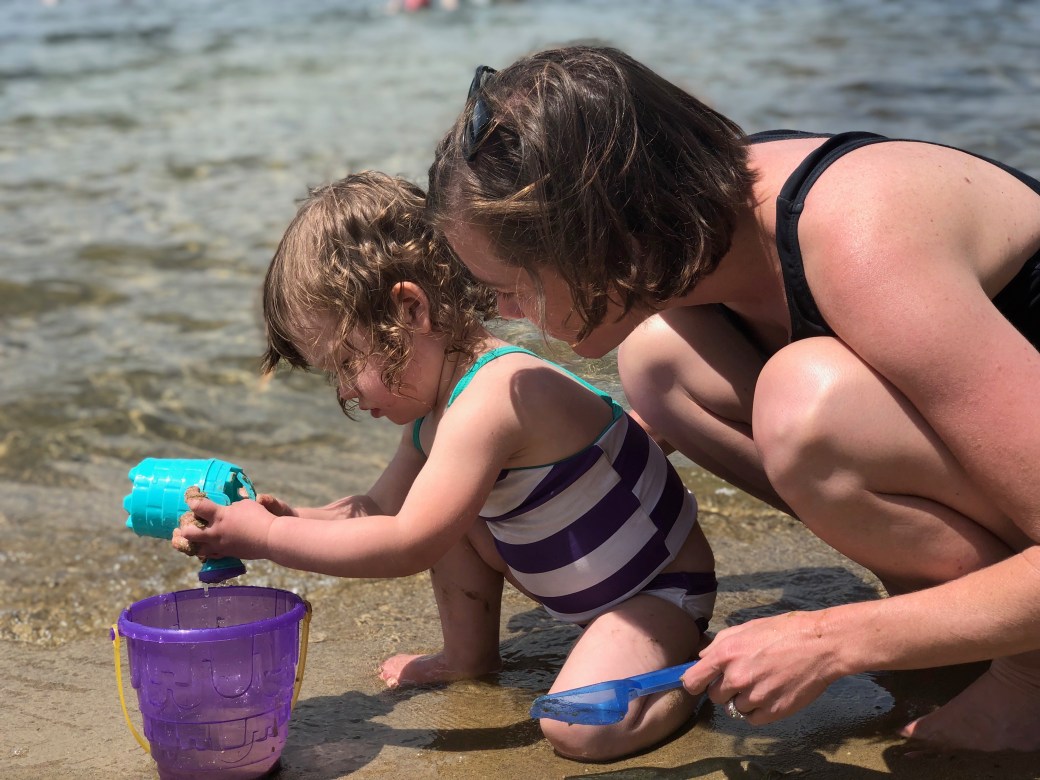
The day before I found out I was pregnant, my wife and I took our daughter to the lake. We had a wonderful day, enjoying the sunshine and the water, the snacks and the sand. I spent hours at the water’s edge with Pidge, digging, scooping, pouring, and building castles. We filled her little purple bucket, packed it down, then turned it over. Pidge squealed with delight. Then the castle came down. Sometimes Pidge stomped on it, sometimes a boat-induced wake washed out its foundation, and sometimes the sand just crumbled. We always built another, and when we did, the delight returned.

My womb is emptying so that it can prepare to be filled again.

The sadness I am feeling is still there. However, unlike the ever-present darkness that enveloped me over the past few days, this sadness comes and goes like waves. And the tide is receding.

I am working with my doctors and midwives to understand this miscarriage. I have requested testing for Rh sensitivity, and the next time I get pregnant, we will monitor my hCG levels closely. If there is anything to be learned, I hope to learn it, even if it just means adjusting my expectations regarding future pregnancies. If nothing can be learned, that is okay, too. Sometimes miscarriages just happen. Sometimes sand castles just crumble. But with effort and hope and support from those who love me, I can build another and our family can delight once again.

IMG_4030

Sad

It feels like there are no words. When we found out I was pregnant, we told our families and our closest friends. Today I had to tell them that I am miscarrying. They all console me and ask if I want to talk, but what is there to say? There is so much to feel, and nothing to say.

Last night I started bleeding while watching a video on how babies develop in the womb. My wife was assigned to watch the film for her Human Growth and Development class, a prerequisite to the nursing program she is trying to get into. I was excited to watch along, and to imagine the new life growing in me.

When I saw the blood, my heart sank. Maybe it’s okay, I told myself. Many women bleed a little in early pregnancy. But it didn’t feel okay.

I dreamt about miscarriage. I dreamt about death and tears and sitting alone on dark bathroom floors.

I woke up to more blood. As I went to the bathroom, more blood. Clots. So much blood. I cried as my body brutally expelled my hopes and dreams. Over the next day or so, I will watch as my body eliminates life.

I walked out to the sun room and sat on the rocking chair. My toddler climbed up into my lap and immediately began kissing my face. “Mom sad? No sad. No Mom sad.” Her little lips pressed together then pressed to my cheek. She cradled my head in her hands and kissed me over and over again.

At least it happened early, I tell myself. I can always try again. But there is little solace there. I know that things will be okay in the long run, but today is not the long run.

I am so thankful for this precious little girl, covering my tear-streaked face with her kisses. I am also overwhelmed with grief for the kisses I had anticipated giving my newborn in February—kisses that will never come to be.

I know I will kiss another. I know my body will heal and I have heard that there is an increased chance of conceiving shortly after miscarriage. I know these things, but right now I don’t feel them.

Yesterday I was pregnant. Today I am not. And right now I just feel sad.

Cycle Day: March

“This is the time of year that makes Vermonters strong.”

It was one of the first things said to me when my wife and I moved to Vermont in 2012. At the time, we didn’t understand. How could we? At the time, we were still star struck by our new state, in awe of the bare trees, the shadows they cast, the rock formations proudly jutting out of the landscape, and the snow. The pretty white snow blanketing any misgivings we may have had about moving 3,000 miles away from our families.

Today, we know. Even as people who love winter, the snow and the skiing, the coziness of inside, we understand the meaning of that statement uttered to us seven years ago. March is hard. Winter, despite its beauty, is long. It is dark and cold and icy. Our days are predominantly spent inside and our skin longs for the warmth of the summer sun. Unlike many places in March, Vermont is not abloom. Vermont still vacillates between arctic chill and sloshy mud. The wind howls and everything, including much of the snow, is brown. So much brown. Everything is dirty, everyone is inside.

Our first spring with a toddler, this March has been especially tough. She has no place to run or stretch or dance in our little home. She began experiencing slight delays in her gross motor development.

Adding more mud to March, Pidge is having health issues. She began experiencing a phenomenon where her hands and feet and lips would occasionally turn blue, something called cyanosis. Her pediatrician ordered some tests, and the results were frightening. Hypothyroidism. Possible autoimmune disease. Possible Type I diabetes. Blockage in the heart. We held back our tears but stress and fear welled up.

I was trying to get pregnant and my period was eight days late, but every pregnancy test was negative. What was going on? I felt trapped between waiting and pregnancy. Women who are trying to conceive monitor their cycle days. I felt like I was in cycle day March.

But here’s the thing. March is how you look at it.

IMG_2372

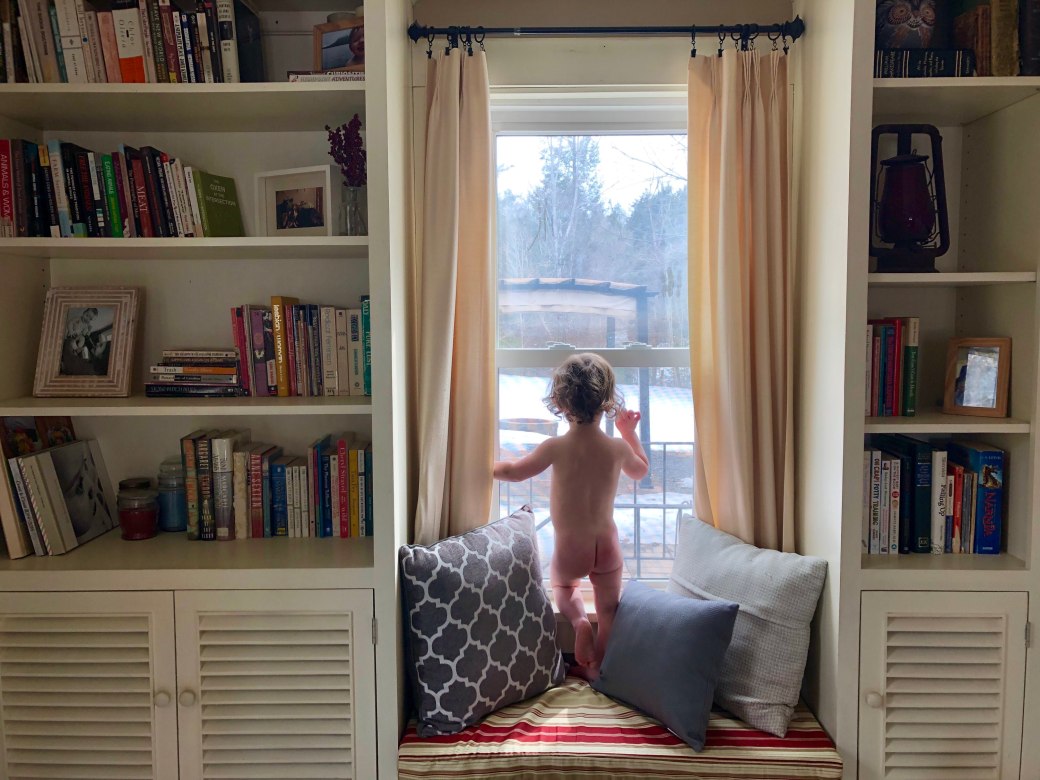
Pidge looking out the window at March

Fifteen years ago, I was living with my brother in Northern California. I remember lounging on my back on the living room sofa reading a book, when I looked up and saw the moon perfectly framed in the highest window. It was full and clear and there was even a redwood tree right next to it, like a postcard picture. I pointed it out to my brother, who was in the kitchen.

Look. The moon.

The only trouble was, from where he was the moon was blocked by a big piece of house. There was no moon, no postcard redwood in his view.

But instead of telling me it wasn’t there, he set down the pan he was washing and walked over to me, leaning and tilting his head until he could see my moon in the window.

And I’m thinking about this because I’m thinking about March, and about what a difference a little perspective can make.

Pidge’s cyanosis led us to have her tested at Dartmouth for a whole host of health issues. We are thankful that we are able to get ahead of these issues, and to treat as necessary. And, according to her pediatric endocrinologist and pediatric cardiologist, her prognosis is actually much better than we thought.

After forty days of waiting, I started my period. I am not pregnant. Not this time. But at least the waiting is finally over. My hope is renewed, and I am excited to try again.

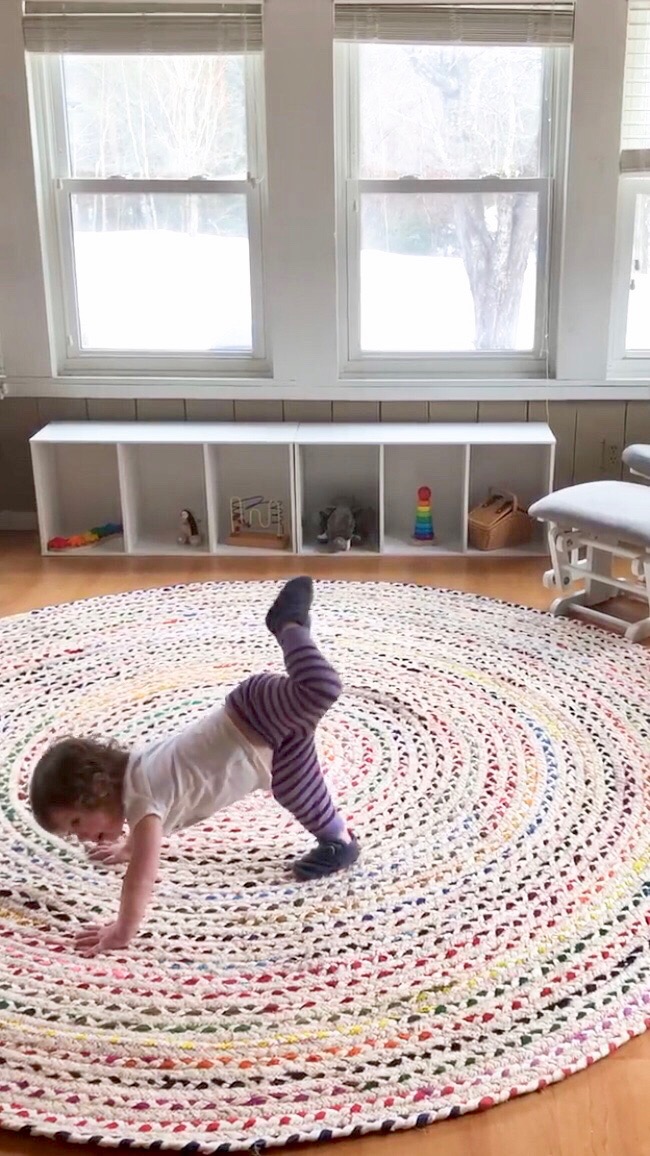
Last Sunday, I redecorated a room in our house. If we are going to be stuck inside, I thought, let’s create some space to move. I got rid of bulky furniture and added a big, bright, colorful rug. When Pidge saw it, her eyes instantly brightened. She ran over to her rug and danced.

Maybe March is tough and beautiful. Maybe the snow is tedious and brilliant. Maybe it is making the most of inside time with a dance on a rainbow rug. Maybe it is just a matter of walking into a new room to come see that there really is a moon in the window.

7A38A4A9-79C4-4E77-B7A2-331379248D88

First Try

Just relax, I told myself. I looked at my phone to pass the time and to occupy my mind. I was in the bedroom alone, preparing myself for my first insemination.

A week earlier, after my first period since our daughter was born had come and gone, I began tracking my ovulation. Tests and mucus and body temperature—before trying to conceive, I had no idea how complicated all of this stuff is. And we’ve got one shot each month, so we have to get it right. No pressure.

Then Thursday morning it happened. The digital indicator on our ovulation predictor kit showed a smiling face. My heart stopped. Oh my gosh, I thought. It’s time.

We called our donor who, several months prior, had signed a contract with us to facilitate the process. He agreed to come over that evening and the next day as well.

I spent the next eight hours desperately trying to focus on work, but my mind was elsewhere. I wish we had tried yesterday, I thought. I knew from my copious amounts of research that it is better to inseminate prior to ovulation. The smiling face indicated that it was likely I would ovulate in the next 6-48 hours, but that’s all. If it was later, we still had time. If it was earlier, we missed the window.

But I had to stay positive and relaxed. Everyone tells you not to stress, because stress inhibits conception. From experience I can say that this is much easier said than done.

I waited in the bedroom. I heard our donor come in, greet my wife and daughter, and then head to the bathroom. A little while later, I heard the sink run. He walked downstairs and said to my wife, “I left it on the counter. Good luck!”

As he drove away, my wife and daughter came into the bedroom. “Mom!” my 18-month-old exclaimed. “Mom, Mom, Mooommmm.” She shimmied onto the bed and climbed on top of me, rubbing her face against mine. My wife got the sterile cup and syringe ready. I laughed. Trying for number 2 is so different than trying for number 1, I thought. My daughter giggled and played with a tube of Pre-seed.

“Okay, Pidge. Let’s go.” My wife scooped up our daughter. “Bye bye!” our daughter waved cheerfully.

I took a deep breath and held my legs up in the air. My wife leaned down and kissed my cheek. She smiled. I smiled back, full of nerves and hope. “As of right now,” she said, “we officially have a chance.”